

Carpenter larks, they mudlark, make their way down. Buffalo Street, down to the Bow River. From their shore thing (2026), a chapbook I produced specifically for this gathering:
a class act. Echinoidea.
enters. the fossil record.
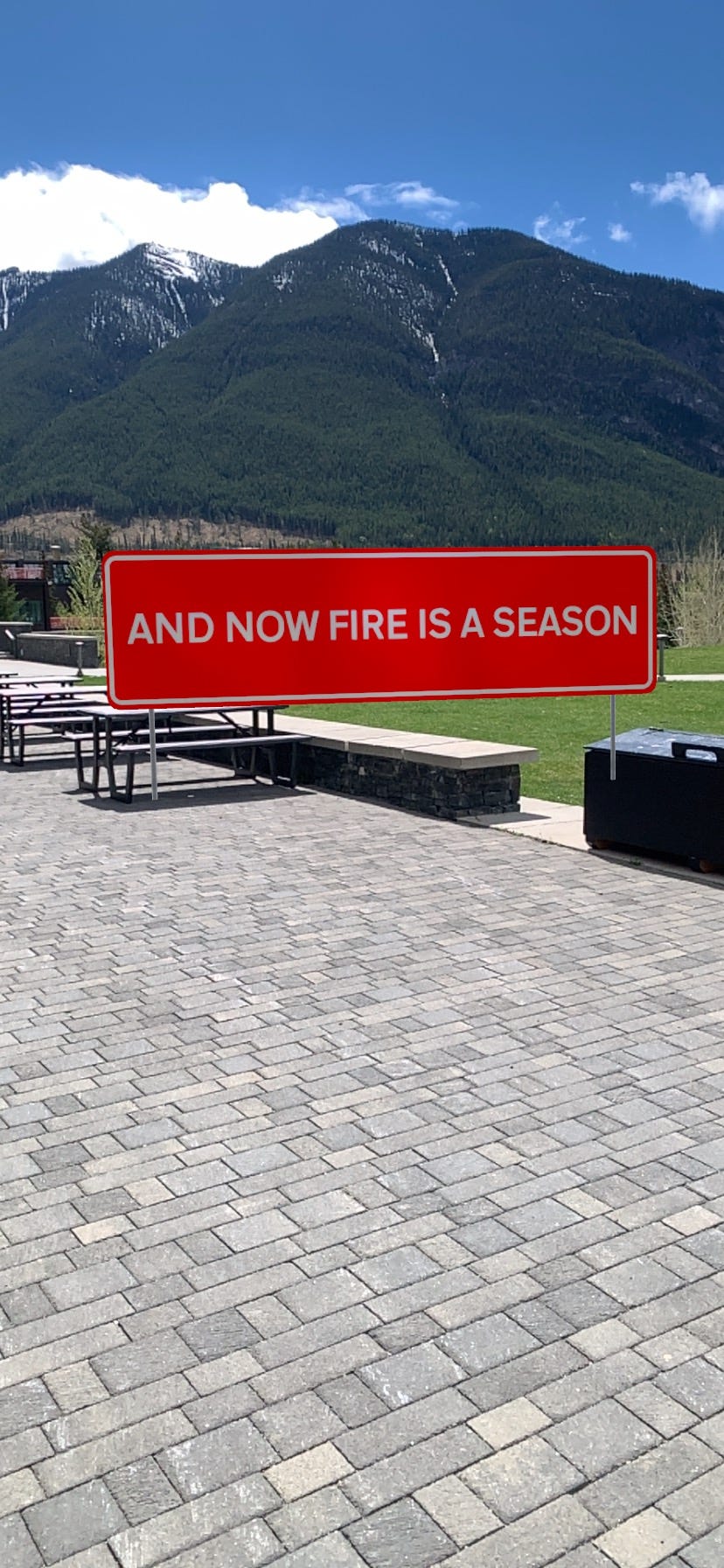
An image on the cover of a fossilized echinoid (sea urchin), as drawn by Theo Rumbsy. As Carpenter says, now further mudlarkers are sending along photographs of their own echinoid fossils, resting atop their copies of this newly-released title. You can “use the chapbook as a handy reference guide,” Carpenter texts, “as the whole first section is about echinoid fossils.” I do not explore on foot the area surrounding this little cluster of buildings—where my room sits, the library, the dining hall—as I suspect I might get turned around too easily, lose half a day attempting to get back where I started. I catch pictures of the mountains, attempting to use the “THIS IS A BAD SIGN” site to overlay signage across these grand vistas.
A turn of the Bow, which I’ve seen from other angles, certainly, other points. An elbow or two within and through Calgary, Canmore, and out here as well, running down from Bow Lake. The confluence of Bow and Elbow, where the core of Calgary took root. A river so threaded, one wonders, possibly named as the sound of an arrow, leaving the hand. Or, as the website for the Town of Banff provides:
The town is located on the Bow River which was used by Indigenous people for millennia for travel, hunting and fishing. For tribes of the Great Plains water was “life” and of great importance. The river was named the Bow because local Indigenous Peoples made bows from Douglas Fir trees that grew along its banks. The Stoney Nakoda name for the Bow River is Ijathibe Wapta “a place where people made bows out of Saskatoon saplings.” In the Blackfoot language, the river is called Makhabn, which means “river where the bow reeds grow.” The bow and arrow were intrinsic to the way of life of many First Nations groups and were often made with one or more additional materials (bone, antler, sinew, intestine) adding strength and flexibility.
One requires a license to lark, to mudlark, anywhere upon the tidal Thames, as Carpenter points out, although such paperwork not required out here. My sister-in-law, Christine’s brother’s wife, who wished to mudlark the Thames during their five years in London, but couldn’t garner an application. Across the Covid-era, certainly, the waiting list for applications grew exponentially. What else might one find, across those tidal shores? Small bits of medieval pottery, Victorian nails, Roman tiles, or possibly a button. Most of a discarded font was recovered at one point, as Christine informed me, during our last London visit. A different sense of the immediate than where we stand. What might one find here? Carpenter’s goals, it would seem, are buried much further back. From the Bow River, Carpenter already returned with a fossil.
And those that have already gone up, or gone into, hiking the further mountains. Carpenter, Goto. Wah, most likely. Caetano, but only after his daily morning workout routines, prior to breakfast. The clear, delighted calm on his face every morning, as he lands at our table.
*
Later that night at Maclab, our scattered table of writers and a nearby table of playwrights. Sharanpal Ruprai, who floats from their group into ours, as she awaits dinner. The differences between playwrights and writers, I’m not entirely sure. I always recall the late R.M. Vaughan’s description of the difference between playwrights and actors. Playwrights at the bar, glaring at the actors at the dance floor and muttering “They ruined my play,” while the actors all waving their arms, dancing and singing “Look at me! Look at me!” I won’t speculate on how true or not this might be. Either way, I sure do miss Richard, especially at times like these.
A story I realize I didn’t even hear from Richard directly, but from Mike O’Connor, quoting Richard. In Toronto, somewhere in the early aughts. It must have been.
One of the group, Sara Graefe, introduces herself as a friend of Stephanie Bolster’s, saying she recognizes me from social media. Wants to introduce herself. Graefe is a Vancouver-based playwright, dramaturge, editor and writer, and three-time winner of the National Arts Centre Young Playwright Search, which is pretty impressive. A group of eight or so in their assembled group, including what looks like Toronto playwright and actor Daniel MacIvor. Wait, is that Daniel MacIvor? I know MacIvor from a multitude of things, including the first season of Twitch City (1998), and as recent as last week, an episode of Law and Order: Toronto. Ruprai offers to introduce me, which I take her up on, although I have to work myself up to it. Marion Bridge (2002), the film version of which I’ve seen, adapted from his play, originally published by Talonbooks in 1999.
I can’t recall what I said to him, but attempted to keep it brief. For the sake of not embarrassing myself more than I already might. Law and Order: Toronto, an episode fictionalizing a serial killer in the gay village, a story close enough it felt a bit uncomfortable, until I saw MacIvor on screen. He wanted to be around, he said, because he wanted to make sure they got it right.
Returning to our group of writers: no one had any clue who MacIvor is, which surprised me. I posted the encounter the following morning to social media, hoping someone, somewhere, would agree it was cool. There were quickly a dozen, all amazed. British Columbia-based poet nathan dueck: “Dear me, do I ever love MacIvor’s work! So much of his dialogue bounces around my brain.” Toronto poet Concetta Principe: “For sure, Daniel MacIvor is a genius. Love every one of his plays in print and when he’s performing.” or Surrey poet and critic Dale Tracy: “A MacIvor play was one of the first things I ever taught, and I like how he thinks just as much now. That IS extremely cool!” Relief, this. Do we all live in such bubbles, otherwise? But my favourite is from Toronto writer Sofi Papamarko, who responds:
He’s such a fucking genius, holy shit.
Former Toronto bookseller, founder and proprietor of the infamous This Ain’t the Rosedale Library (1979-2010), Charlie Huisken, responds to the fact that my group hadn’t been aware of who he even was:
Too many creative people toiling in silos.
That wasn’t always the case.
When did it change?