the banff notebook :
, eleven days in may (part four,

Last night was our opening gathering, including remarks at dinner by Jill Ehnenn, the Chair of the English, Film and Creative Writing Department, as well as by the Creative Writing Program Coordinator, Jordan Abel. A full contingent, more than a dozen writers across a whole wall of tables, including those otherwise in the space, and most welcome. Adèle Barclay, Sharanpal Ruprai, Kit Dobson. I learn that fiction writer Hiromi Goto works these days as a farm-hand, growing Japanese organic vegetables in W̱SÁNEĆ Territory, daily digging hands through the soil. For Goto, this is actually a return to the soil, having been raised on their parents’ mushroom farm, a thread fictionalized through their debut novel, Chorus of Mushrooms (1994). I am curious about this return to farm work, what Goto feels they’ve gained through this particular return to childhood landscapes and labour, what my dairy farm-raised self has so far resisted. I very much resist even attending our own suburban backyard, to assist with Christine’s gardening. I have had enough through this life, I tell myself, although perhaps there are lessons to learn through the returning. “Mind you, the story can be anything,” Goto writes, mid-way through Chorus of Mushrooms, “but there have to be details. People love details.” Edmonton-based poet Marilyn Dumont and I discover we share a birthday, so I ask what her time of day, curious. She was just before noon, I a few hours earlier. So you’re older! she laughs. As Goto, in that infamous debut, offers:
The wind blows from the west, the west, the west, again. Shrieking from the throats, the very teeth of the monstrosities they call mountains. From the bowels of the sea, the moisture sucked onto the jagged peaks, only dust left to blow across this prairie bowl. But sometimes, the wind swirls from the south and takes an easterly curve. I can smell the compost, then, from the compost barn. If they are turning the compost over, the smell is ammonia acrid. I have never been there, to the compost barn. I have never seen the mushrooms growing. I have never left this chair.
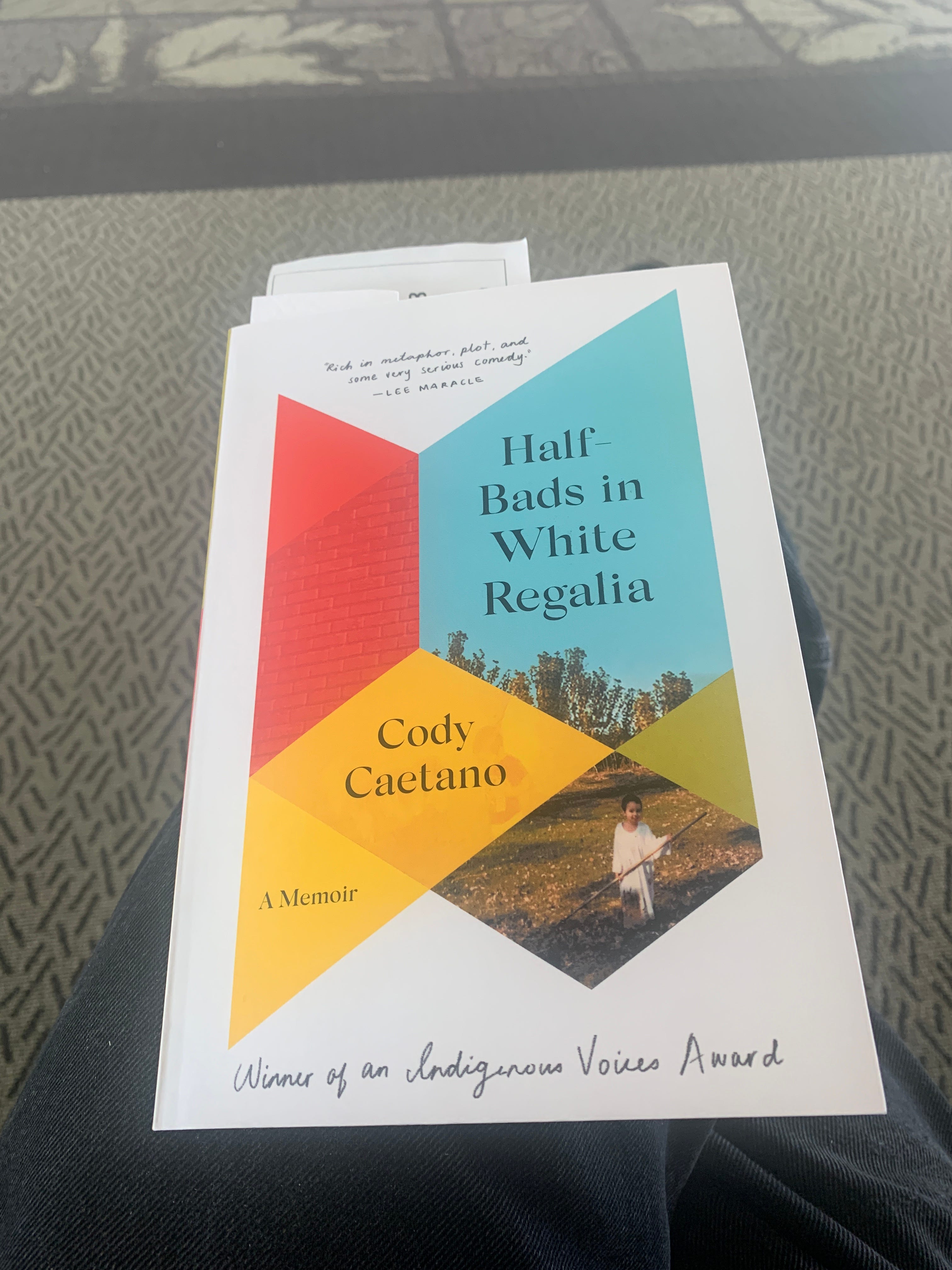
On the flight in, I read through Half-Bads in White Regalia (2022), the debut memoir by this past year’s writer-in-residence, Toronto-based writer and literary agent, Cody Caetano. Caetano was one the few writers through this week of participants, alongside Pruden and Kerr, I knew nothing of, so I thought it worth going through his book en route, to get a sense of him and his work. He writes of a childhood set amid chaos, through cycles of poverty, neglect and disinterested parents: when his mother moved in with a partner, leaving her children, including the author, around nine years old, alone in a house as the electricity cut, and the septic tank burst. A harrowing scene of muck the yard and up through the floors, as mould set in enough to rot through the walls. Composed in beautifully-written prose, the story Caetano tells are as harrowing a tale of childhood as I’ve heard. “Ask any half-bad to tell you the story about how their bad half came to be and they’ll probably begin with the buckle.” the memoir opens. “The buckle is a rumble that hijacks the interior faculties to make one thing and act without compunction. The buckle attacks the locus of focus and apes the half-bad’s best intentions, only to play them like a chump chimp. And if left unchecked, the buckle will keep going until the frequencies connecting them to community fizzle out into the ether of rumour and myth.”
At Maclab Bistro, an hour with notebook, pen, manuscript. Sketching out notes on Alberta, the character, not the province. A conversation with Fred Wah about memory, notebooks. How he could never manage the attention for a journal or diary, abandoned after a few pages, a few days. Myself also, never able to sustain the attention, working my journal through other means. Perhaps these pages, an idea I articulated also, prior, across the green notebook, but most often letters, sent out to friends. If you want to know where I was during any particular period, dig through my archive at the University of Calgary, and read through my letters.
A lock on a particular trove of letters. As suggested by others. You’ll just have to wait.
Wah tells a story of himself and Roy Miki visiting Ellie Nichol, soon after the death of Toronto poet bpNichol (1944-1988). Miki, of course, not only a renowned Vancouver poet, activist and scholar, but a critic, bibliographer and occasional publisher of Nichol’s work over the years. We were moving a couch, Ellie told them, and found these two notebooks. Do you want to see them? Oh my, yes, the two said. How this accident led to Wah editing a selection of Nichol’s previously-unpublished notebook pages in an issue of Miki’s West Coast Line. As we discuss between us, Nichol’s notebooks were process pages, quite literally his space for thinking, and something, as Wah said, Barrie always had with him, always would pull out and scratch something in. Even if he was teaching a class, mid-sentence, and had a thought, he would pull out his notebook. Thoughts towards poems, essays, stories, visual poems, cartoons. Joining the conversation, Derek Beaulieu suggests that Nichol’s notebooks were curious in that they never included such things as phone numbers, addresses or grocery lists. A different kind of notebook than those I worked for years, until my current domestic, which ties me far more to house than those decades of Centretown wandering. Fred also offers that Ellie claimed Barrie was terrible at groceries.
Imagine this as cover blurb. “Barrie was terrible at groceries. — Ellie Nichol.”
My own spiral-bound full-size notebook: my own space for first drafts of stray thoughts, reviews, essays, fiction, short notes as reminders. The years before a homelife with Christine, our young ladies and subsequent kittens, my twenties working smaller bound notebooks, which would include that at more, including those elements of life, from phone numbers, appointment reminders, grocery lists and other ephemera. Back when my daily routine across Centretown on foot, a bag or two of books, notebook, manuscripts and the like, requiring a notebook as catch-all. A place to remember things. Now the Google Calendar reminds me of moments that require me to attend, and other stray notes that might float through a text, or an email. I used to be out all day every day, but the bulk of this now at my small basement desk. The life-journal is no longer required.
Edmonton writer Conor Kerr, at the bar just prior to dinner, a notebook as well. I should have asked what his holds.