
the banff notebook :
, eleven days in may (part five,

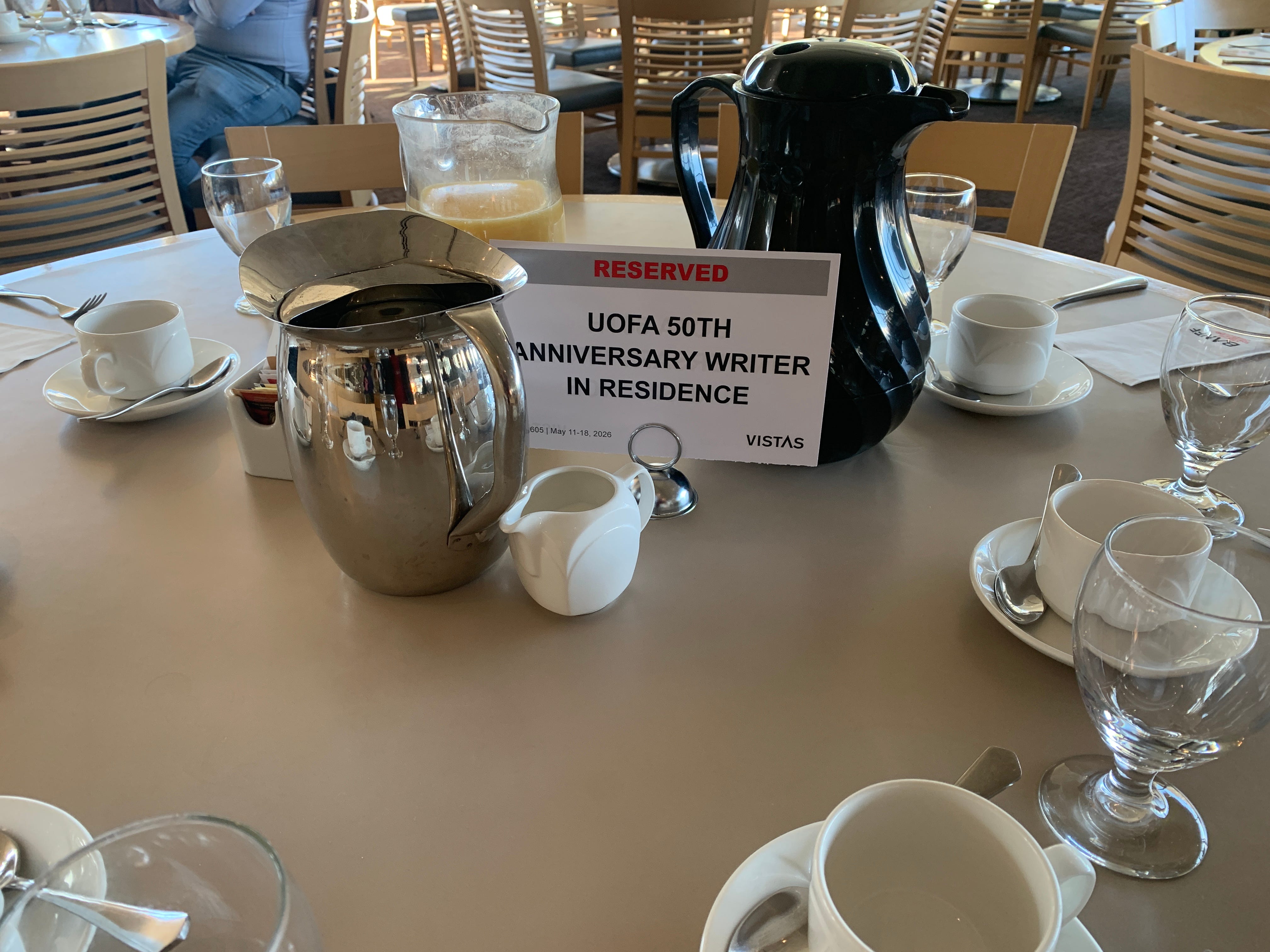
Morning, overcast. Which clears. A cloud, half up the morning. Embracing the mountainside. The hug of this morning cloud, this dawn-set incline.
I’m first to land at breakfast, again. After an hour’s work at my desk, knowing I was up far too early to head out the door. Today, as my body still on Ontario time, informing me two hours early: 8am, time to get up. However late I might remain awake, and yet, I resist fully landing in this particular time zone. It would mean I might miss my 7am shuttle out of here on Monday. Direct back from Calgary to Ottawa in time to relieve father-in-law and his wife from childcare.
Wah, asking me at last night’s dinner about a Kingston writer he’d heard of, as he couldn’t recall her name. Someone working between languages, English and Dutch, and how he was curious about the work, the poems. Ah yes, Sadiqa de Meijer, she does good work. He asked if I knew her writing, and mentioned that he was curious to see her new poetry title. I told him he needed to read the essays, certainly. This morning, I realized I not only had a copy of the new poetry collection, Qaf’s People (2026), but I had it with me, landing in my mailbox a day or two before packing for this particular trip. What are the odds? I’d originally thought I might begin to read through it on the plane, instead focusing on other things, other titles. Caetano’s memoir, for example. I brought my copy along to breakfast, aiming to loan it to Wah while here. As her opening poem, “Creation Story,” begins:
Firstly, two bodies collide
with each other this elsewhere—
Whether Wah and myself or Wah and de Meijer, this is not the context she’d intended, but the suggestion still stands. The accidents, collisions, of fate. I’m curious to hear what he thinks of it.
*
To do a half-thing, because I want to do all the things. To have a half-thought. Why am I here.
At lunch, Jordan Abel describes how ryan fitzpatrick nearly fell off a mountain, walking the trail down to town that kept going down, down. They were headed to Chili’s. That’s a lot to unpack, more than I might have space or bandwidth to fathom. From Abel’s new poetry title, Dad Era, and the failure of his own father, for lessons he was forced to learn on his own. But lessons, I’d say, he’s learned well:
To be creative. To be loving. To be generous and kind
and human were all lessons that I learned
alone in the snow.
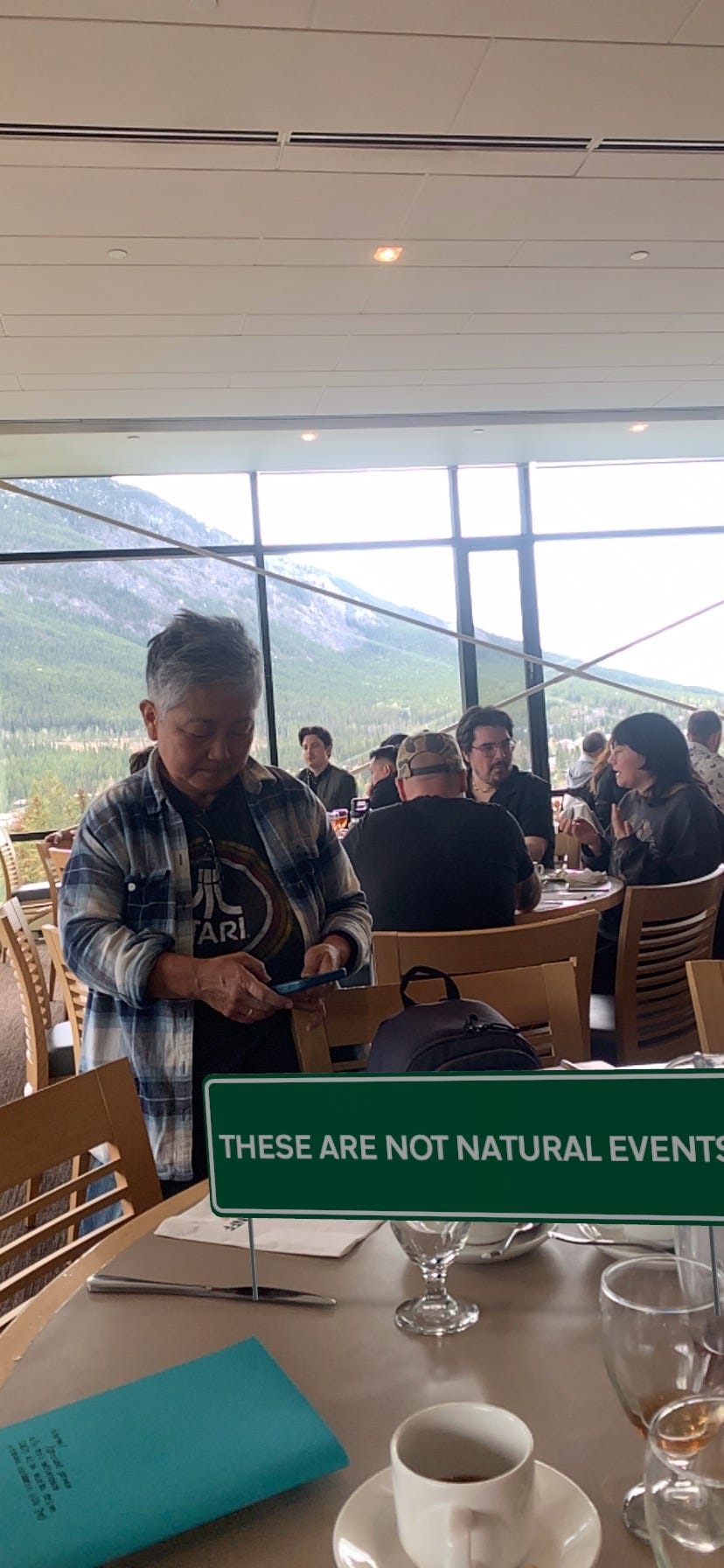
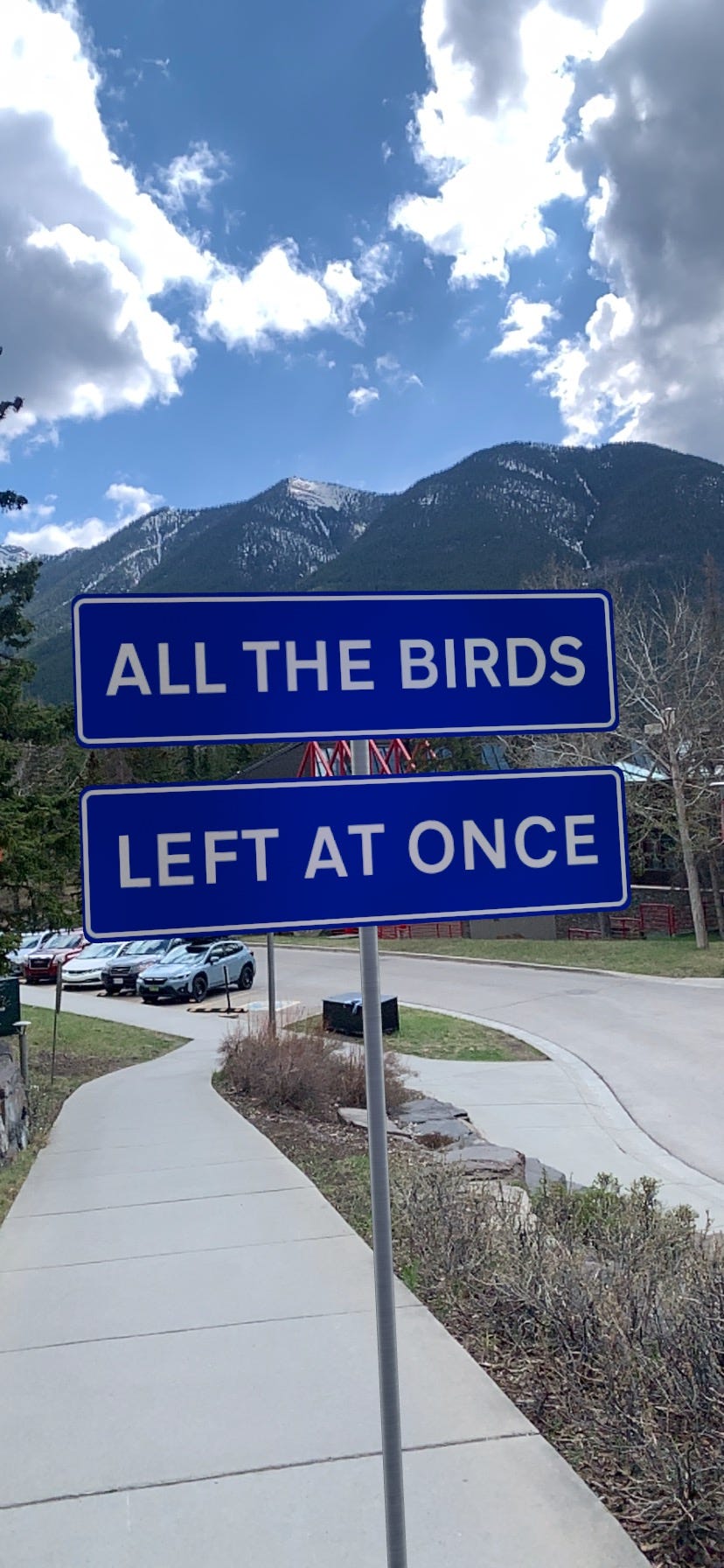
J.R. Carpenter begins to describe a really fascinating commissioned AR poetry project they worked on a while back, “THIS IS NOT A GOOD SIGN.” Produced in collaboration with Tokyo-based artist and game designer Tomo Kihara, this a project sits at the intersection of Carpenter’s clipped and accumulative ecopoetic lyric engagements and Kihara’s approach to gaming. The pair hadn’t figured out quite where their interests might connect until Carpenter introduced him to Yoko Ono’s seminal artist’s book, Grapefruit: A Book of Instructions and Drawings (1964), a kind of Rosetta Stone for his understanding of the meeting between poetry, poem fragments, and conceptual engagement. The website allows one to overlay particular signage across one’s cellphone camera, placing the signage of digital text upon real landscapes, with signage texts such as “WE USED TO HAVE GLACIERS” and “AND NOW FIRE IS A SEASON.” I attempt to capture one of these across a cellphone image of Carpenter explaining further details of the project to Fred Wah, but all I manage is a series of images of Hiromi Goto in the background of our table, completely unaware of my camera.
Goto, who has also been engaging with image and text, a few recent pieces I’ve seen overlaying Japanese script upon their own photographs, reminiscent of some of the work of the late poet and visual artist Roy K. Kiyooka (1926-1994). Images, at least the two I’ve seen, suggest Goto’s own engagement with the land through these works, especially given this current work as a farm hand.
*
The food, oh the food. I’d only heard rumours of the food here, but I now understand. The wealth of options across these buffet-style spreads. I must be careful.
A week before landing west, discovering a copy of Marilyn Dumont’s South Side of a Kinless River (2024) in my errant home library, a book that seems to have passed right by, unseen. My new birthday twin, along with Fredericton poet Triny Finlay, American poet and editor Janet Holmes, New Brunswick poet and publisher Allan Cooper, Hamilton, Ontario fiction writer Miranda Hill, the late Colorado poet Thomas G. Valle. I told him, Julie. The Ides of March, already. Beware. When I inform Hill of Dumont’s shared birthday via text, she responds: Be sure to collect her membership dues.
A conversation with Dumont at dinner, around not the altitude, but the dry climate. Daphne Marlatt suggests the mountains have far less snow upon them than they should, this time of year. I’ve never seen it so dry, she says, the grass and the trees. The way the air hovers, holds, just around one’s head.
As Dumont’s poem “nipiy,” from the collection, opens:
If our gratitude dries parched, we think nothing of water
if our tongues shrink, we think of nothing but water
of water, nothing of water – our foresight shortened
dry, memory of these-dry-days
Evidence of last night’s rain on the sidewalk that evaporates, quick. Not a mark on this place.
Great post, rob. Iam jealous about the food as well as the conversations. 👍📚❤️